

What is a house?
How what we build is shaped by stories, taxes, economics, climate, and culture. And your taste in rugs.
Does this seem like an odd question? I mean, you might be sitting in one right now. It has walls, windows, doors, furniture (you have the best taste), and hopefully a roof. Physically, you probably have a good conception of it.
But what if we thought about this question a bit more deeply?
Why is your house the way it is? The size it is? Why does it have the number of windows it does? Why is it made of bricks, or blocks, or wood? Or if you’re a little pig, straw?
(In which case, you might want to think about the risks of fire and wolves.)
We should really think about a “house” as a story: fundamentally, a story about giving people somewhere to live. It is also a story of costs, incentives, and challenges, like climate and weather.
Wind-owed (a taxing problem)
If you wander around Bath (I mean, it is lovely), you might notice that some windows on the Georgian terraces appear to be bricked up. If you also find time to wander around Winchester and Alresford (again, lovely), you will see the same.
Lovely old houses, full of character, with windows deemed no longer necessary.
In 1696, William III (or William of Orange, so called because he was a member of the Dutch royal house rather than a sunbed fan) introduced the window tax. The tax was introduced to replace revenue lost from coin clipping (chipping off bits of coins as they were made from valuable metals like gold) and as a wealth-targeting alternative to an unpopular income tax.
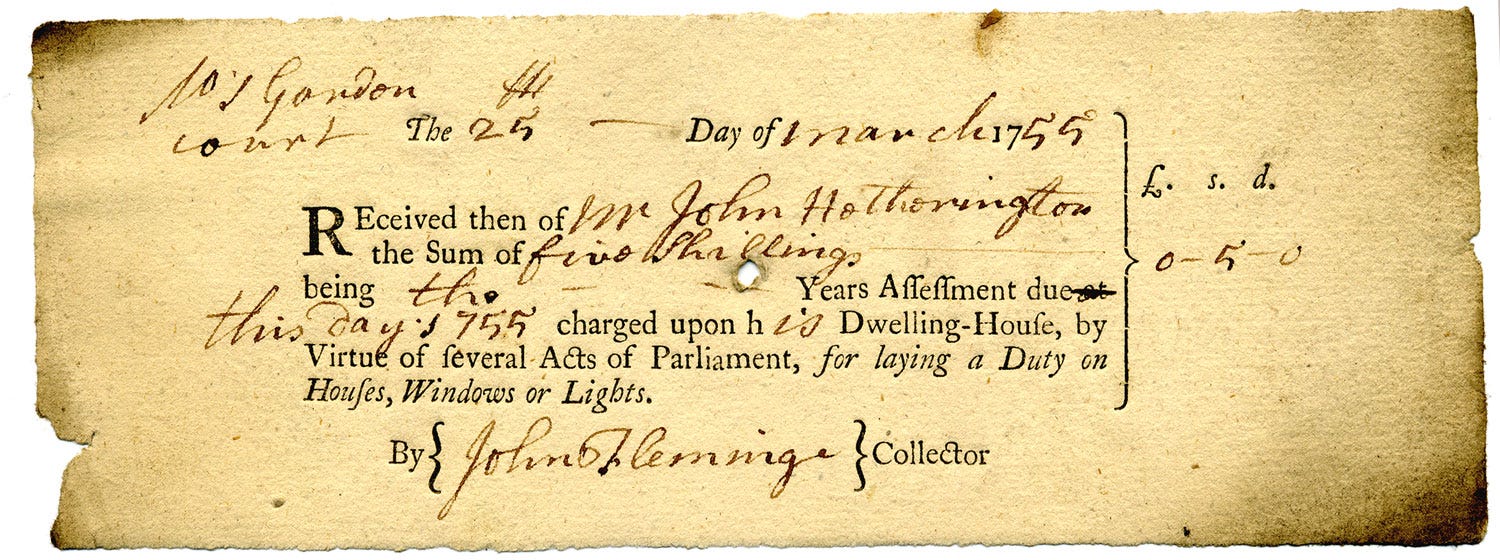
Windows were a proxy for wealth that a tax collector could observe from the street. The more windows you had, the more you were probably worth. Seems legit.
The tax was banded. Everyone paid 2 shillings (about £2 in 2026 money), plus a charge based on the number of windows. In 1825, the threshold for paying anything was limited to houses with more than eight windows. By the Napoleonic Wars, a large house could owe several pounds a year. A skilled labourer would earn around 15 shillings a week, or £39 a year.
Just as now, people tried to find ways to avoid paying the tax. You didn’t need to move your money to the Cayman Islands (bit of a job back then); the easiest thing to do was to remove some windows. Fewer windows = less tax liability.
Homeowners bricked up windows and even painted fake windows onto the brick for aesthetic reasons. Of course, there were downsides to this (alongside the loss of tax income).
Landlords of subdivided tenements blocked all the windows they could. The tenements were taxed as a single dwelling, which increased their liability. This created dark, airless rooms which bred typhoid and cholera.
Slim-pickings
Amsterdam is one of my favourite cities. Beautiful, trammy, and with a nice pace to it. Also, I do enjoy a pancake breakfast.
As you travel along its canals, you notice the narrow houses that give it its distinctive look. From the 16th and 17th centuries, the Dutch taxed canal houses on the width of their frontage. As a result, merchants built narrow, tall and deep to keep the bill down.
Plots to build were standardised at around 5–7 metres wide. The skinniest house in Amsterdam is about one metre across. The side effect is seen in the staircases, so steep and narrow that homes still carry external hoisting hooks to lift furniture through the upstairs windows.
Taxing decisions
Deciding which taxes to levy is one of the most powerful levers a government has to shape people’s decisions. Tax choices change how people live, and how the world around us is shaped.
Let’s say you’ve decided to build your own house and have been featured on the top TV hit, Grand Designs.
(You or your partner will become pregnant, you will decide to project manage yourself, and you will remember you have an expensive flat you can sell to raise your budget.)
What if there were (unlikely) taxes on the number or size of windows or doors? Or (more likely) that meant certain materials were more expensive? Or (also pretty likely) were there incentives to make the house more insulated and to install solar panels?
These choices would affect the house you build, and therefore the way you live, and therefore the built environment for as long as the house stands. A house is shaped by the pressures around it.
A house from an era tells you a lot about what was going on and what was valued at that time.
Downsizing
There is an oft-repeated factoid that the UK builds the smallest homes in Europe. One of those stories that makes a good depressing headline. But it isn’t true.
We hit a bit of a nadir in the 1980s, but since then, new builds have got bigger. So we have somewhere to put all our Vinted purchases.
In 1961, the Parker Morris Committee published ‘Homes for Today and Tomorrow’, and then set out standards published in 1963. From 1967, these standards were adopted in public housing, and continue to be in Scotland. But they were abandoned in England in 1980.
The average new UK home sits at about 90 sqm. on average. This compares to ~137 in Denmark. Germany ~93, France ~93, US ~200 for contrast. They’re below average, but not the smallest.
New builds have fewer bedrooms than their 1970s equivalents (2.95 vs 3.53), which are ~20% smaller than 1970s homes. Houses are smaller now than at any point since at least the 1930s.
The reasons are obvious enough. A high population density (almost 300 people per sq km), lots of people (over 60 million) are squeezed onto 94,000 square miles. Land is expensive, not easy to come by, and tough to get planning permission for. And there are lots and lots of building regulations.
All this encourages developers to squeeze as many houses as they can out of the land they have.
One for the money (affordability)
In 2022, the average house in the UK cost nine times the average annual salary. The last time that was true was 1876 - the year Alexander Graham Bell was granted the first US patent for the telephone (Ahoy hoy!).
Following Alexander’s improvement on cups and string, the UK saw a 50-year decline in the price-to-earnings ratio. This was driven by the construction of more, smaller houses and rising incomes for the average person. Between 1851 and 1911, the UK housing stock doubled (from 3.8 to 8.9 million).
To be more up to date, the average house price in 1975 was £10,978, and in 2025 it was £272,819. An increase of 2,385%. Over the same period, wages increased by 1,400%, and consumer good prices increased by 8-900%.
Pressures from population growth, living standards, and demographic changes impact demand for housing, housing types, and the size and quality of housing. Houses built in 1850, 1970, and 2025 would differ in ways that reflect the social pressures of their times, not to mention architectural fashions and the use and abuse of coving and cornices.
Authentically fake
Styles and fashions come and go. At one point, there was a trend to make everything from concrete. That didn’t last. Luckily for some, I guess.
There’s a good chance your house is at least partly made from bricks. It was not always so. Brick was a luxury for most of English history.
Brickmaking lapsed after the Romans left in 410 (without even leaving a note) and revived in the Middle Ages. Under the Tudors and Stuarts (1485–1714 inclusive), only the wealthy built in brick, e.g. Hampton Court. Everyone else built timber frames packed with wattle and daub (sexy).
Then our old friend, health and safety, reared its head. Events like the Great Fire of London (1666) pushed people away from timber framing towards brick construction. Which just don’t like catching light.
You might be thinking, “Ah, yes, but there are those lovely old Tudor houses with dark beams, white plaster, classic.” Well, the Tudors generally limewashed over timber or let the oak silver. The classic black-and-white look was actually a Victorian invention.
I await the great concrete revival with my little brutalist badge on.
Climbing climate
I live in the northwest of England. And when I say that, you probably have an immediate idea of the weather challenges I face. Rain. Lots of rain (Keanu Reeves voice).
Northwest Europe is where the UK sits. UK houses are built to retain heat for a cold, wet climate. Brick has high thermal mass (good at heat retention, don’t you know), which suits the cold.
In a 30°C heatwave (no laughing, southern European inhabitants), British homes warm by 5°C within three hours. Spanish homes, all white and with those pretty window shutters, only heat up by 2.2°C in the same period.
Conversely, they also lose heat 3 x faster than houses in Norway and Germany because of the ageing housing stock. 37% of UK homes were built before 1946, when they didn’t have the technology and know-how of modern insulation (but had more facial hair).
Spanish houses are built for a very different reality. Thick walls, external shutters, and internal courtyards to act as heat sinks (that can cut cooling energy by more than 10%).
Climate change means the UK is getting different weather, and home design will have to adapt. It might be time to start a shutter-fitting business in the UK.
House proud
So, what is a house? Is it just some walls, windows, doors and a roof?
No. It’s a lot of things. It’s a settlement from a negotiation. A negotiation between what we want and what we can have, with concessions to the weather, the taxman, and the rules and regulations. That is what makes a house. A compromise of what you could have and what you can make of it with a sledgehammer and a paintbrush.
What made your house the way it is? And why did you choose those curtains?